
A Flag Without Presence: Territory, Armed Groups and the Lost Address of Our Youth
Blog post description.
POLITICS
Lupetu W. Tshibengabo
12/21/20254 min temps de lecture
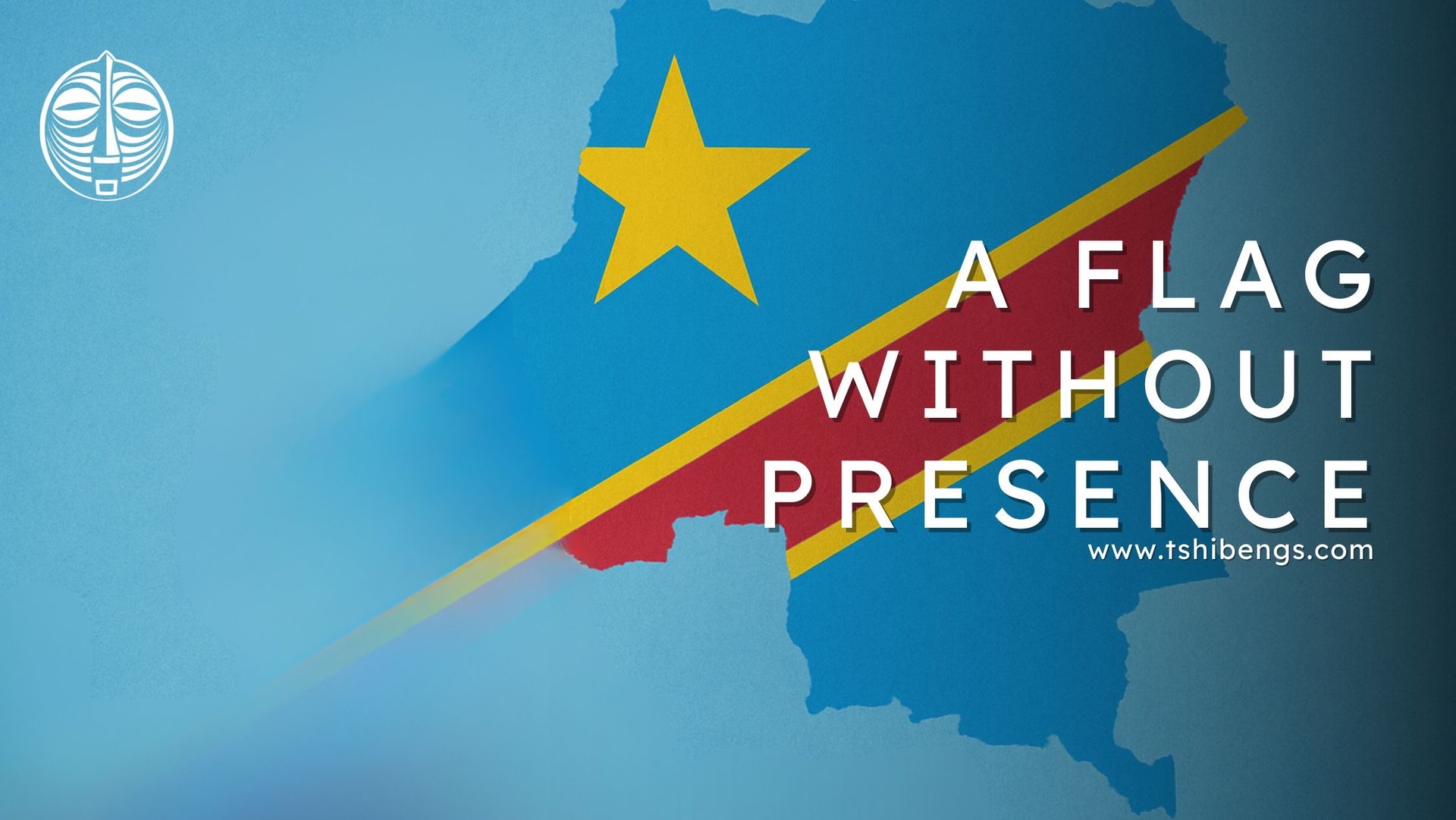
Congo is vast.
On a map, the Democratic Republic of Congo stretches across the heart of Africa like a continent within a continent. More than 2.3 million square kilometers. Nine neighboring countries. From Kinshasa to Goma, the road distance is roughly equivalent to driving from Paris to Istanbul.
Yet in many areas, the Congolese state is more present on the map than on the ground.
This gap between the flag and the reality of presence is one of the central crises of our time. It is also directly linked to another challenge: what I call “youth without a nation to build.”
Territory Without Presence
In theory, sovereignty means that the state’s authority is recognized over every square kilometer of its territory. In practice, Congo lives in a different reality.
Entire regions are effectively governed by:
Armed groups
Foreign-backed militias
Traditional leaders operating without state support
Mining barons and economic networks
Parallel administrations and informal tax systems
When a farmer, miner or trader interacts daily with a militia commander, a traditional chief or an NGO worker — but almost never with a representative of the Republic — what does “the state” mean to them?
For millions, the state is a rumor, not a reality.
The Geography of Insecurity
Statistics can sometimes hide the human pain behind them, but they remain necessary to understand the scale.
In recent years:
More than 120 armed groups have operated in eastern Congo.
Millions of people have been displaced by conflicts, including the resurgence of the M23 rebellion.
Entire territories function as ungoverned or alternatively governed spaces.
These are not just numbers. They represent a vacuum of authority.
Nature, and geopolitics, hate a vacuum. When the state retreats, others advance.
Not only with guns, but with:
Informal taxation
Illegal border crossings
Smuggling routes
Influence operations
Parallel justice systems
In such spaces, minerals can be extracted without regulation, people can be displaced without protection, and foreign interests can operate without accountability.
Maps and Myths
Look at a map of the DRC and you will see a colorful shape, with clear borders and labeled provinces. It suggests order, unity, clarity.
But maps are often optimistic stories.
The real map — the one that matters for daily life — is drawn not only by borders, but by presence:
Where are there functioning courts?
Where is the army properly deployed and paid?
Where do people feel protected by the Republic, not extorted by it?
Where do children grow up seeing the state as a provider, not just a flag?
Without presence, territory is an invitation. An invitation to invasion, to secession, to pillage, to fragmentation.
This is why I write:
“Territory without presence becomes invasion.”
Youth Without a Nation to Build
At the same time that parts of our territory live without the state, our youth live without a clear national project.
Congo is one of the youngest countries on Earth:
Around 66% of the population is under 25.
Every year, about 1.2 million young Congolese turn 18.
Hundreds of thousands finish secondary school. Most do not enter university, nor technical institutes.
Many enter the informal economy, not by choice, but by necessity. Others join artisanal mines, migrate to cities, or dream of leaving the country altogether.
In the absence of a clear national project, other forces step in:
Armed groups offer identity, salary and a sense of belonging.
Illegal mines offer quick cash, however dangerous.
Foreign recruiters offer the dream of migrating to “Europe” or “America.”
Politicians mobilize youth as crowds, not as citizens.
Criminal networks recruit them in trafficking and fraud.
The problem is not that our youth are lazy or unpatriotic. The problem is that the Republic has not given them a structured address — a place to go where their energy is transformed into nation-building.
As I write in the book:
“Our youth have not lost courage — they have lost direction.”
The Demographic Crossroads
A young population can be a blessing or a ticking time bomb.
In countries like South Korea or Singapore, youth were mobilized into disciplined national projects. Through conscription, civic service, industrial policy and education, they became the engine of development.
In countries like Somalia or Haiti, or during the chaotic aftermath of the Arab Spring, youth surges without structure contributed to chronic instability.
Congo stands at such a crossroads.
We can continue on the current path, where young people are left to improvise their future in an informal, insecure and often abusive environment. Or we can decide, collectively, to create a framework where:
Every young person has a period of structured service — military, civic or technical.
This service is tied to real projects: infrastructure, agriculture, education, health, digitalization, territorial protection.
Youth see themselves not as spectators of the state, but as builders of the nation.
Compulsory Service as Structure, Not Punishment
When people hear “compulsory national service,” many think of forced military training, wasted time, or politicized indoctrination.
That is not the vision I propose.
The SMCO model — Service Militaire & Civil Obligatoire — is not about punishing youth. It is about organizing them.
Imagine a Congo where:
Young men and women spend 24 months in service after secondary school.
Some choose the military track: learning discipline, defense, logistics, engineering.
Others choose the civic track: working in agriculture, public works, education, health campaigns, environmental protection.
All receive basic training in citizenship, ethics, history and national values.
At the end, they leave with skills, references, and a sense of belonging to something bigger than themselves.
In a country as large and strategic as Congo, such a system is not a luxury. It is a necessity.
Reoccupying the Map
Ultimately, the crisis of territory and the crisis of youth are the same crisis: a crisis of presence.
Presence of the state on the ground
Presence of opportunities in the lives of young people
Presence of a national narrative that tells them: “You are needed here”
To reoccupy our map, we must send more than soldiers. We must send teachers, engineers, doctors, agronomists, digital experts and trained youth to every corner of the country.
The alternative is clear: others will continue to occupy the spaces we abandon — with their soldiers, their contracts, their militias and their interests.
A flag without presence is a piece of cloth.
A territory without opportunities is a departure lounge.
A youth without a nation to build is a revolution waiting for a trigger.
The rise of the Wazalendo is about more than heroism on the battlefield. It is about reclaiming every kilometer of our land and every year of our youth for the project of rebuilding the Republic.