The Paradox of a Giant: Why Congo Is Not Poor, Only Unprotected
The Democratic Republic of Congo is often described as “one of the poorest countries in the world.” This is not just wrong — it is dangerous. In this article, I unpack the myth of Congolese poverty and explain why the real issue is the absence of protection, organization, and national will. Congo is not a beggar. It is a giant that has never been allowed to stand.
Lupetu W. Tshibengabo
12/7/20255 min temps de lecture
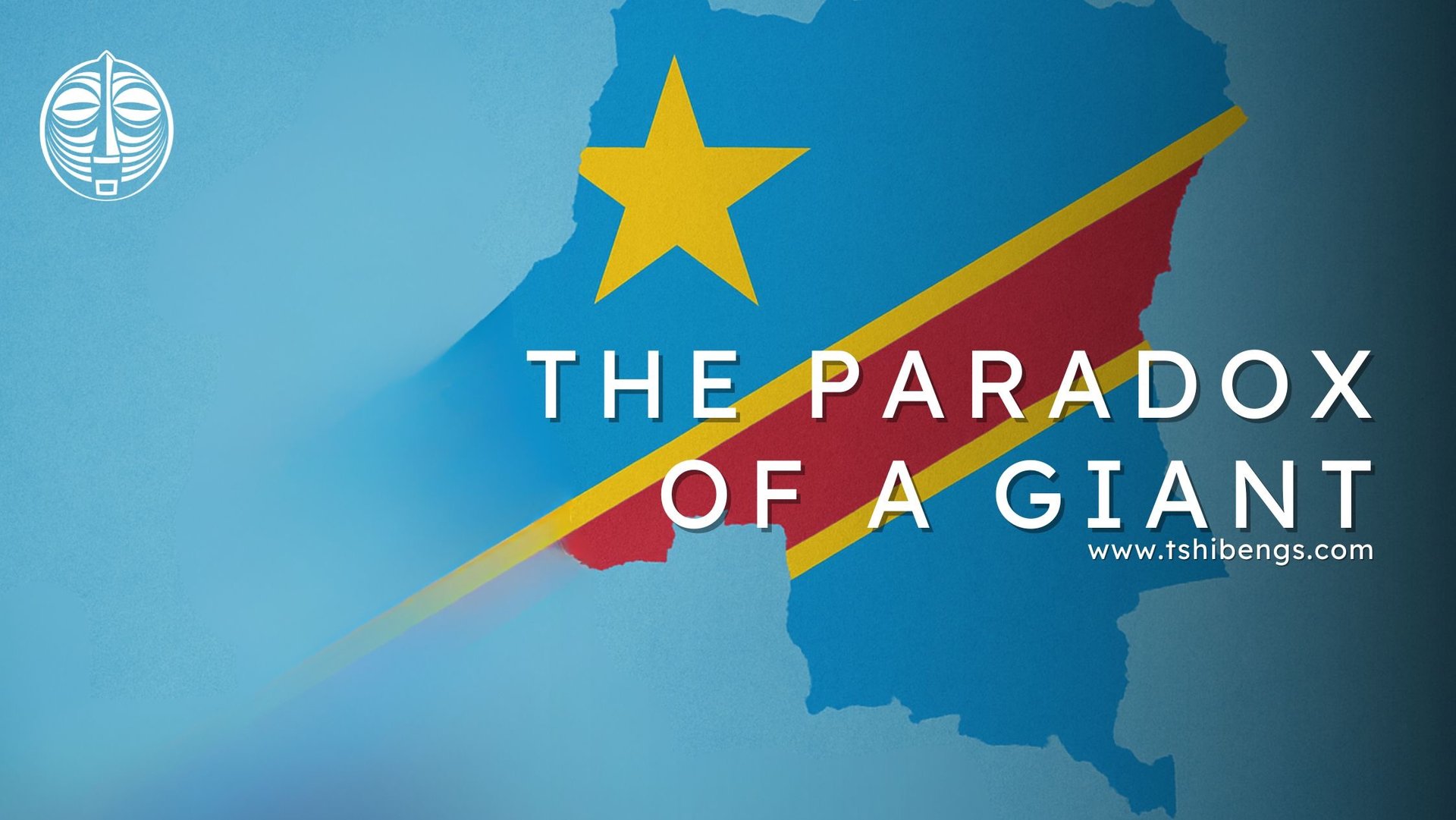
If you search the name “Democratic Republic of Congo” on the internet, you will likely find the same phrase repeated over and over: “one of the poorest countries in the world.”
It appears in reports, headlines, NGO campaigns and donor documents. It has been repeated so often that many Congolese themselves have started to believe it.
But what if this sentence is not only misleading, but dangerous? What if the problem is not that Congo is poor, but that it is unprotected?
This is the starting point of the paradox that defines modern Congo — a country whose land is rich enough to power the future of the planet, while its people still struggle to secure the basics of daily life.
The Myth of Poverty
Let’s start with a simple contrast.
On a humid morning in Kinshasa, a vendor sells phone credit under a mango tree. On her small wooden table lie scratch cards and a cheap Android smartphone. That phone was assembled in Shenzhen, powered by Congolese cobalt, connected to a global network of satellites and fiber optic cables.
The minerals inside it may have been dug out of the ground by another Congolese, a thousand kilometers away in a rebel-controlled area, for a few dollars a day.
By the time the device reaches our vendor’s hands in Kinshasa, value has multiplied — but not for her. She still lives in a neighborhood without stable electricity, with unreliable water and limited security.
This is not just a sad story. It is a system.
Congo’s soil holds an estimated $24 trillion worth of mineral wealth. The country supplies the majority of the world’s cobalt, an essential component of the batteries in electric vehicles, smartphones, and renewable energy storage. Its forests help the planet breathe. Its rivers have the potential to electrify half the African continent. Its agricultural land could feed more than two billion people.
Poor? No.
Plundered? Absolutely.
The Difference Between Poverty and Plunder
Poverty is a condition where resources are absent. Plunder is a condition in which resources exist but are extracted without protection.
The Democratic Republic of Congo is not a desert with nothing under the soil. It is a treasure chest with broken locks, weak guards, and neighbors who have learned how to reach in.
The core problem is not the absence of wealth, but the absence of:
Security infrastructure to protect that wealth
Institutional capacity to manage it
Organized national will to defend it for the benefit of Congolese citizens
In other words, the problem is sovereignty — not just as a flag or a national anthem, but as effective control over land, resources, and destiny.
That is why I write in The Rise of the Wazalendo:
“The difference between poverty and plunder is sovereignty.”
A Giant With Unsteady Knees
Congo is often described as a “sleeping giant.” The metaphor is powerful, but incomplete. A sleeping giant can wake up on its own. Our situation is more complex.
Congo is a giant whose arms are strong but whose knees are unsteady. Strong arms, because the land is blessed with minerals, water, forests, and youth. Weak knees, because the systems needed to secure and organize that strength are fragile or absent.
This fragility is visible everywhere:
Minerals leave the country as raw materials, return as expensive products.
Communities living on top of wealth experience none of the benefits, only the insecurity.
State presence is felt more at election time than in daily protection, justice, or services.
The result is a permanent contradiction: a rich land where people live poor lives.
Wealth Without Guardians
From the colonial era to today, a bitter pattern repeats: Congo’s riches travel outward; insecurity flows inward.
Under King Leopold II, rubber and ivory were extracted with unimaginable brutality. In the post-independence era, copper, cobalt, coltan, and gold followed the same path, now wrapped in the language of contracts, concessions, and foreign investment.
Today, cobalt from Congolese soil powers electric vehicles marketed as “green” and “ethical” in the Global North. Yet many of the people mining that cobalt cannot afford an electric light in their own homes.
This is what happens when wealth has no guardians.
When borders are porous, minerals leave unnoticed.
When institutions are weak, contracts are signed that benefit everyone except citizens.
When security is outsourced to foreign actors or private interests, the state slowly disappears from its own territory.
To call this situation simply "poverty" is to insult both the intelligence and the dignity of the Congolese people. Our problem is not that we have nothing. Our problem is that what we have is not protected, organized, or claimed.
Territory Without Presence, Youth Without Direction
The paradox goes even deeper.
Congo is the 11th largest country on Earth, sharing borders with nine neighbors. In some regions, the national flag flies over areas where the state itself is barely present. Entire zones are controlled by armed groups, traditional chiefs, economic barons or foreign-backed militias.
At the same time, two-thirds of the population is under 25. Every year, more than a million young Congolese enter adulthood. Many of them are full of energy, ambition and creativity. But without a clear national project, without structured paths into service, training or productive work, their energy is often channeled into survival — or captured by those who offer quick money and false belonging.
This is why I argue:
Wealth without sovereignty becomes plunder.
Territory without presence becomes invasion.
Youth without structure becomes rebellion.
Our crisis is not fundamentally economic. It is existential. It is about who we are, who we want to be, and whether we are willing to organize ourselves to defend that identity.
A Question of Sovereignty
So, where do we go from here?
The first step is mental. We must stop repeating, uncritically, that Congo is simply “poor.” Words shape imagination. Imagination shapes policy. Policy shapes reality.
If we see ourselves only as a victim, we will act like a victim. If we see ourselves as a rich but unorganized giant, the question changes from “Who will save us?” to “How will we organize ourselves to protect what we have?”
This shift forces us to ask new questions:
How do we build a security architecture that protects our territory and our people?
How do we reform institutions so that they manage resources in the interests of citizens, not foreign powers or local elites?
How do we mobilize our youth not as spectators or crowds for hire, but as builders of the nation?
Toward the Rise of the Wazalendo
Under President Félix Tshisekedi, we have seen signs that the Congolese people are no longer willing to remain passive spectators. The emergence of the Wazalendo — patriotic citizens who stand up to defend their communities against foreign-backed rebellions — is one example of this awakening.
But citizen courage alone is not enough. It must be channeled into structure.
That is why this book argues for a new national architecture based on compulsory military and civic service — SMCO, Service Militaire & Civil Obligatoire — to organize youth, secure territory, and transform wealth into shared prosperity.
Before we can build roads, schools, and industries that last, we must ensure that they are not constantly destroyed, looted, or captured. Before we can talk about development, we must talk about defense — not only in the military sense, but in the sense of defending our dignity, our resources, and our future.
Congo is not condemned to remain a paradox.
It can become what it has always had the potential to be: a pillar of African sovereignty and global stability. But this will not happen by accident. It will happen when every Congolese — youth, soldier, farmer, teacher, entrepreneur — sees themselves as a guardian of the land, not just a survivor in it.
The rise of the Wazalendo begins with a simple truth:
We are not poor. We are unprotected.
And that can change.